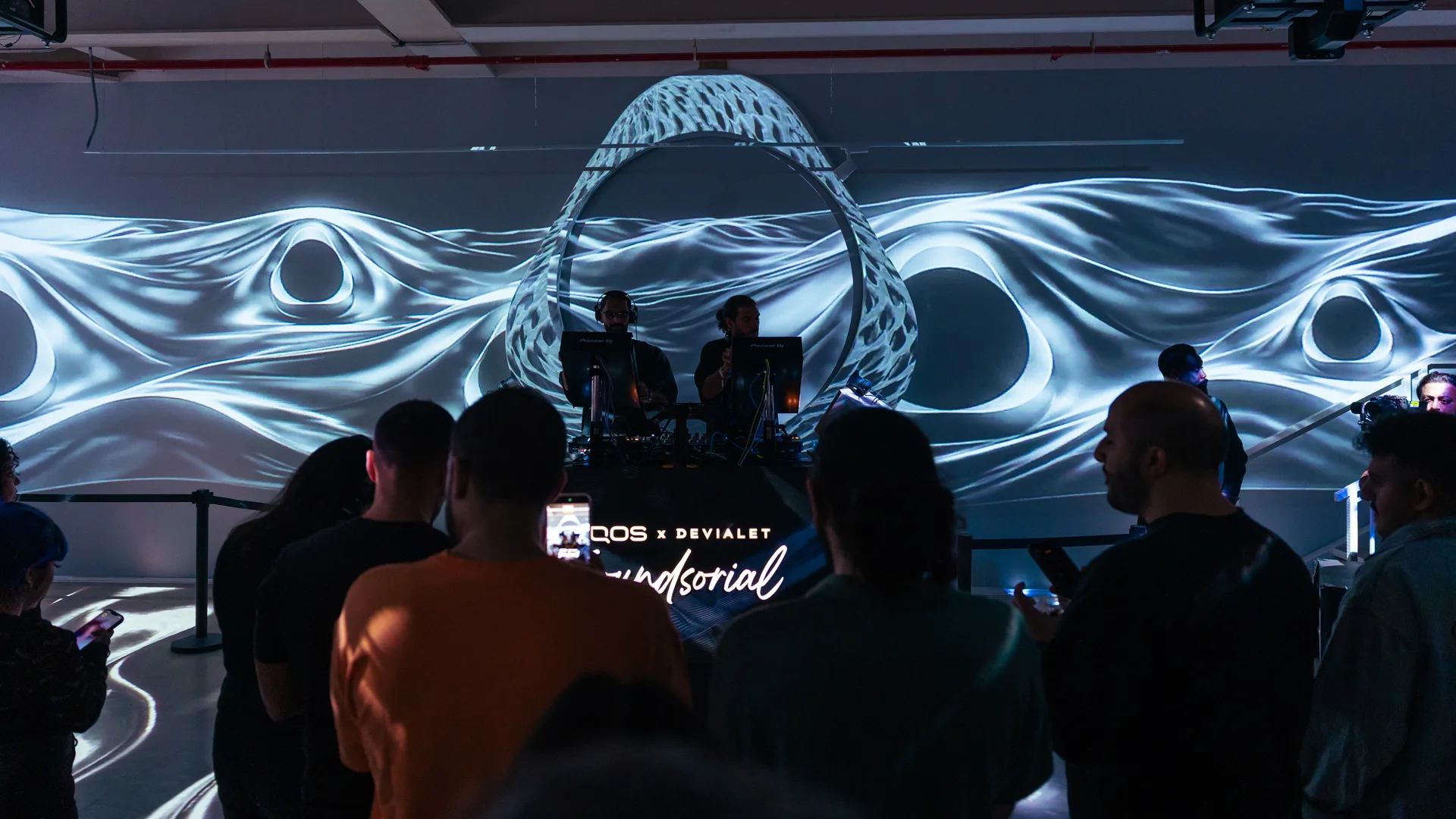
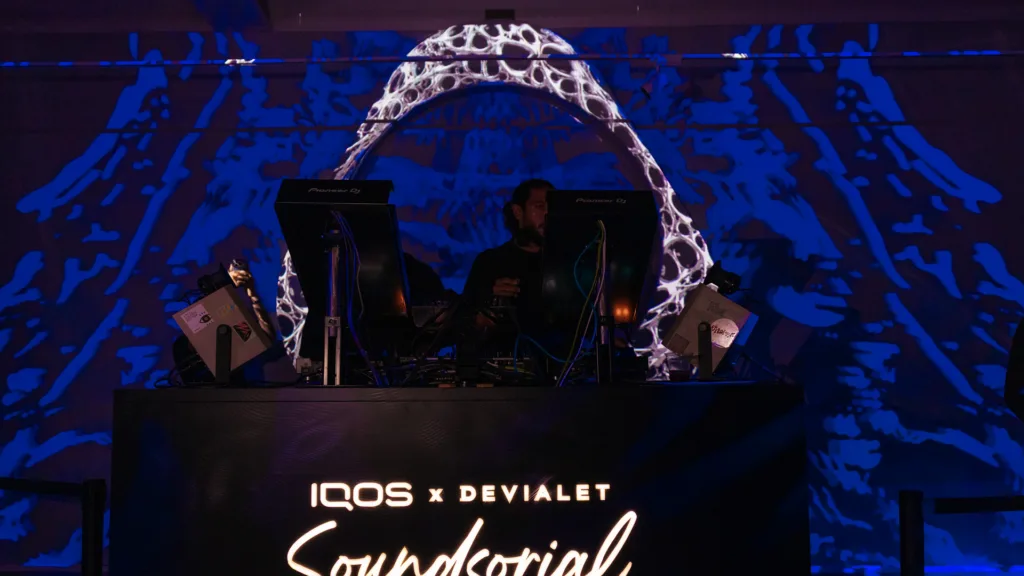
At IQOS x Devialet’s event in Jeddah, a ten-minute composition by Saudi brothers and DJ/producer duo Dish Dash formed the centre of a performance built around music and 360-degree visuals. Developed with visual designer John Dave, the piece connected changes in rhythm and intensity to the imagery surrounding the audience.
Brothers Abbas and Hassan Ghazzawi have been part of Saudi electronic music since its underground years, building a career that has taken them onto some of the region’s biggest stages while continuing to shape the scene at home through their own music, events and label.
The event brought the collaboration to Saudi Arabia following its unveiling during Milan Design Week. The partnership between IQOS and audio company Devialet combines a limited-edition design piece with a curated sound experience.
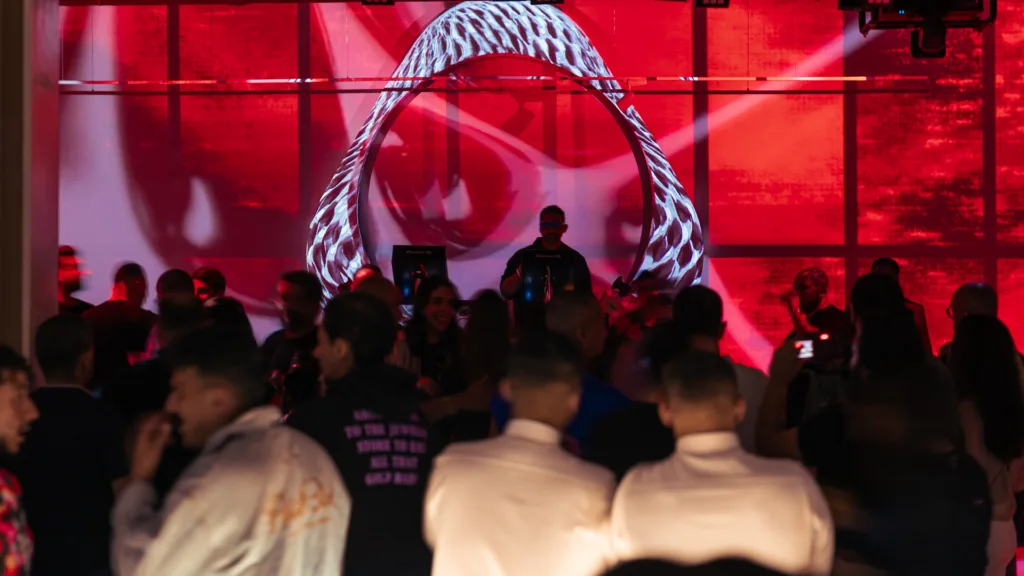
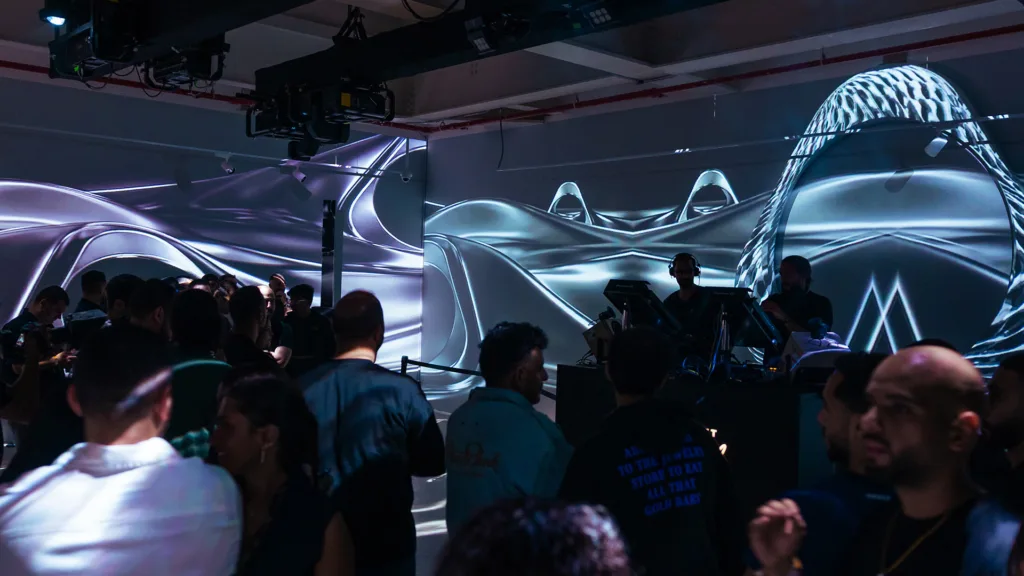
The Jeddah performance explored ‘Soundsorial’, a concept connecting sound with sight and physical sensation. Its visual language drew on linear art, using repetition, variations in density and fragmented patterns to give musical movement a visible form.
Dish Dash developed the composition alongside the visuals, allowing each to influence the other. Their role also gave the project a local perspective: the duo brought their own musical vocabulary to a concept first presented in Milan.
Their involvement connects the event to a broader chapter in Saudi electronic music. Having emerged from a scene of small, independently organised gatherings, Dish Dash have since helped build local electronic culture through IN ACT, the record label and event series they co-founded.
Read More
Dish Dash spoke with Complex MENA about the creative decisions behind the Jeddah performance and their ambitions for Saudi electronic music.
Complex MENA: How did creating music and visuals together change your approach to the performance?
Dish Dash: ‘When visuals and sound are built as one language from the start, you stop thinking in terms of ‘set’ and ‘show’ separately. For the IQOS Devialet performance, every transition was placed with the visual arc in mind, not just the energy curve.
There were moments where we deliberately pulled back sonically so the visuals could breathe and lead, and other moments where the drop was as much a visual cue as a musical one. It changes how you DJ. You’re not just reading the crowd, you’re reading the room as a canvas.’
CM: The project began in Milan. How did you bring your own identity to its Saudi interpretation?
DD: ‘Writing from zero meant every movement in the music could have a visual consequence, so the two were developed together rather than one being fitted to the other. A shift in the low end is a shift on screen.
It also meant we got to do it our way. The textures, the rhythms, the phrasing, all of that comes from where we’re from, so the piece sounds like us rather than like a template for this kind of production.’
CM: For those who couldn’t attend, was the piece more ambient or beat-driven?
DD: ‘It’s one continuous build, so asking if it was ambient or beat-driven doesn’t quite work. It’s both, in sequence, and the meaning is in the accumulation.
It’s the kind of thing you had to be inside. The visuals wrapping around you, the system, the air in the room, all of it landing together.’
CM: What feels most different about Saudi electronic music now compared with when you started?
DD: ‘We used to play shows where the whole night existed on a group chat. You’d find out about it the same day, and half the people in the room were the same faces every time, because there were only so many of us.
‘Now we look out and we don’t recognise most of the crowd, and that’s the best thing that’s happened. They know the tracks. They know when the switch is coming. Some of them are DJs themselves.
‘The biggest change isn’t the production or the budgets. It’s that a kid in Jeddah today can decide to make electronic music and it’s a normal decision. For us it was not a normal decision. We had no example to point at.’
CM: What makes performing in Saudi Arabia different for you today?
DD: ‘Playing abroad is about scale. Playing here is about history, because we’ve watched this audience grow up.
‘With IN ACT especially, we’re not just showing up to perform, we’ve been part of building the thing we’re standing in. There are people in those rooms who were at shows with us 15 years ago when nobody knew what any of this was. When you see those faces, the set stops feeling like a booking. It feels like a checkpoint in something you’ve been doing together for over a decade.’
CM: What should the scene protect as it grows?
DD: ‘Ambition, honestly.
‘Right now Saudi electronic music is at the stage where people are still trying things because nobody has told them what the formula is yet. That’s the most valuable thing we have. The moment a formula appears, and it will, everything starts sounding like the last successful show.
‘The other thing is that the scene has to keep producing its own ideas rather than importing them. It’s easy at this stage to just book the big international names, fill the room, and call it a healthy scene. But a scene isn’t measured by who you can fly in. It’s measured by what comes out of it. Whether Saudi artists are making music people elsewhere want to play.
‘That’s the shift we want to see over the next few years. Less proving we can host it, more proving we can make it.’