

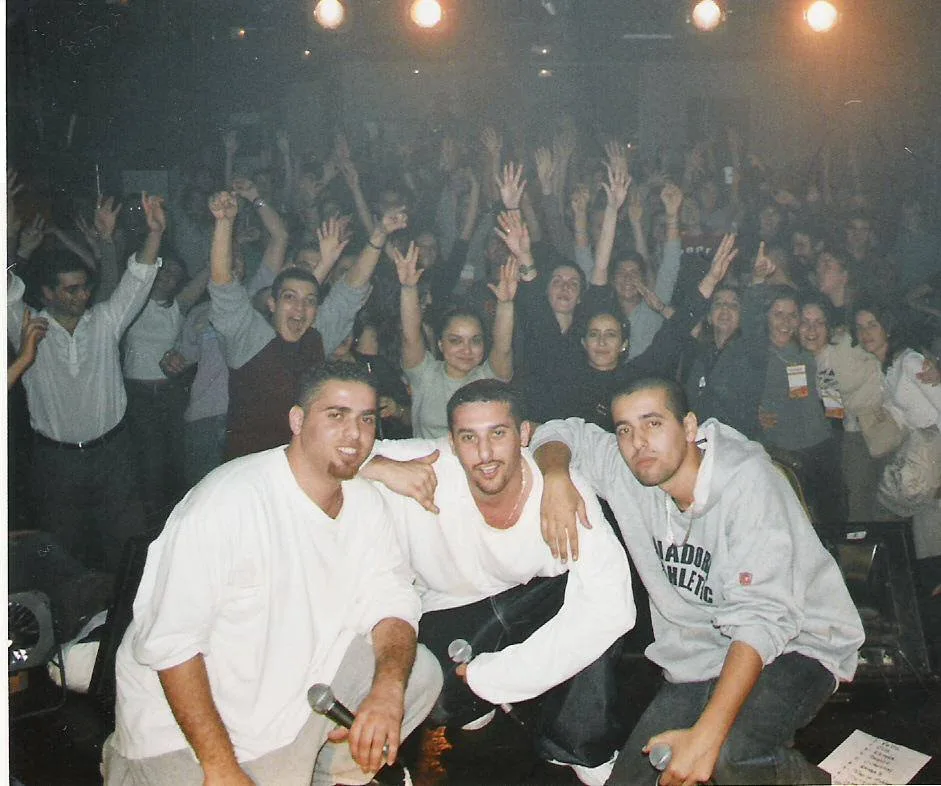
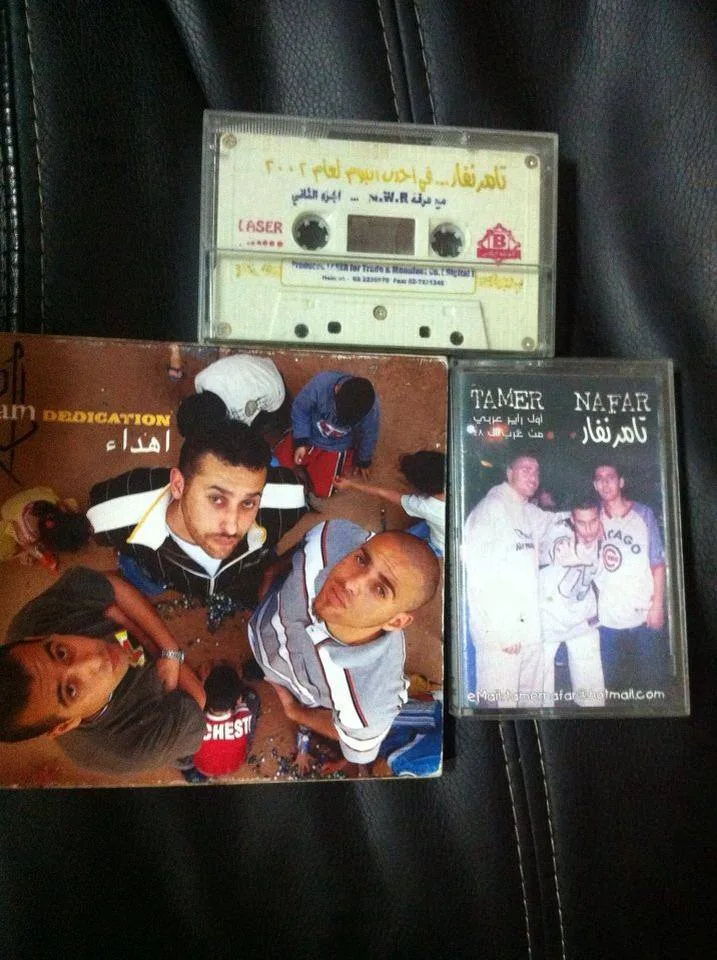
Twenty years ago, three young men from the city of Lydda pronounced their agenda clearly: dedication. An uncompromising dedication, carried to this day, to their raps and their craft, and a literal translation of the title of their first album: Ihda’ (Dedication), a 15-track album dedicated, quite literally, to a newly founded generation of Arabic rap listeners.
Although active since 1998, when brothers Tamer Nafar ,18, and Suhel Nafar, 14, joined forces with Mahmood Jrere (15) to form DAM, the crew’s real global breakthrough arrived in 2001 with their single “Who’s the Terrorist?”.
Based in what’s colloquially known as the ‘48 territories (areas within Israel’s 1948 borders), the track landed a feature in Rolling Stone France and reportedly racked up over a million downloads in the first week of release. More importantly, it opened the door for DAM to record their debut album, Ihda.’
“I was still in high school when we decided to start DAM. We didn’t really know what it meant back then, we were just kids, excited to make music that touched our hearts. We weren’t financially stable, and as we grew up and decided to make an album, we didn’t realise it would take us five years to finish it,” says Suhel.

“In 2001, after our first sold-out show in Haifa with 3,000 people in the crowd, we took the money we made and bought an MPC 3000 and an Arabic keyboard. That’s when I started producing and sampling Arabic sounds, trying to create a new genre that blended Arabic music with hip-hop drums.” he continues.
Read More
A few years later, that same MPC 3000 was sold in exchange for studio time. With a few more shows and financial support from friends, DAM finally recorded Ihda’’’.
Five Years of Instinct and Obsession
Ihda’ opens up with “Mukadime,” the intro track, sampling a speech by former Egyptian president Gamal Abdel Nasser. Grainy yet powerful, the track sets the tone for a carefully composed album, heavy with its samples and layered concepts.
“I remember we showed “Who’s The Terrorist?” to a snobbish highbrow friend who criticised our lyrics as being ‘unscholarly’ and ‘shallow’, and instead, he put on a cassette for Gamal Abdel Nasser,” Tamer Nafar, co-founder of DAM, recalls.
“I could’ve taken the cassette right then and there and used it but the youthful ego in me went on to search for the cassette myself to sample. It was like ‘yes, you know who Gamal Abdel Nasser is, but I will be responsible for a whole new generation knowing him too.’ And obviously, back then, there was no YouTube, meaning we spent a night or two manually cutting the hour-long cassette down to a minute-long sample,” says Tamer Nafar.
This is one story of many. For five years, the rappers were in active pursuit of inspiration. Everywhere, there was a sample; at any moment, another concept came into formation.
The second track, “Mali Huriye” (I Don’t Have Freedom), starts with a question and ends with poetry spoken by a child. The passage is taken from Arna’s Children (2003), a film by Juliano Mer Khamis, founder of the Freedom Theatre in Jenin refugee camp.
The crew had watched the film with Mer Khamis after wrapping the music video shoot for their single, “Born Here,” which he also directed. Like Gamal Abdel Nasser’s speech, the words resonated deeply, eventually finding a new life on DAM’s album. The sampling, however, wasn’t always smooth sailing.
“Some samples were easy to clear, like Juliano’s, as he was a friend of ours, or the sample from Tawfiq Ziad. I went to his house and showed the song to his wife, Um el-Amin, and she approved of it,” says Tamer.
Clearing Samples, One Coincidence at a Time
Other tracks were cleared by pure coincidence, “‘On Da Dam’ (It’s Dam), we used a sample from Madraset El Moshaghbeen (1971) [classical Egyptian comedy play], but we had no way of clearing it,” he explains.
“Coincidentally, there was a film of ours being screened at a festival in Berlin,” Tamer continues. “And by chance, in the hall next to ours, there was a screening of the film The Yacoubian Building (2006). We passed by to watch the film and we saw Nour El-Sherif. I went to Nouri El-Sherif and asked if we could speak for a minute. He kind of ignored me, and frankly, I came off a bit rude, but I was able to get across my request, so he just asked me to give him my phone number,” Tamer recalls.
“Then the next day, my father picks up the phone and tells me it’s Nour El-Sherif. I had to explain it’s THE Nour El-Sherif, who called to give me Saeed Saleh’s number. Saeed Saleh had an office under a sweets shop, and I remember he didn’t know how to send me the fax. It took him maybe two days to figure it out. It was a crazy period, seriously.”
Tamer emphasizes both the honour and humour dealing with legendary names in the Arab entertainment industry. Mahmood Jrere interjects: “I think in the end he just cleared it over the phone.”
For a hip-hop crew in the early 2000s, and before labels came into play, clearing samples wasn’t even on the agenda. That’s why “Who’s The Terrorist?”, which uses the instrumental from “If I Was Santa” by Atmosphere, wasn’t cleared until nearly seven years later, when it appeared in Slingshot Hip Hop (2008), a film by J. Reem Salloum, in which DAM are featured, ahead of its premiere at the Sundance Film Festival.
For DAM, the creative process has always been instinctive. The words just flowed, and the songs just came to be. Everything else was secondary. This was their approach when creating Dedication.
“At that time, we would hold the pen and write without any restrictions,” says Jrere. “Yes, there were metaphors, and we knew how to put on a show, but we would just write what we’re feeling at the moment. It’s very different from how we operate now as artists. It was like a divine gift. I mean, I feel that today writing is a longer process, and it has a lot of self-criticism, a lot of self-flagellation, which is different from how it went with Ihda’,’” he says.
“There was more heart and more courage; now I feel there is more engineering. This is good, and this is good, but both concepts are different,” Jrere adds.
This is when Tamer interjects to argue that their work today is bolder, but he still agrees with Jrere to a certain degree. He gives an analogy: “It’s like this one story of the child who was walking in the dark with the horse, not seeing anything in the forest. The child kept saying to the horse, ‘I can’t see the horizon, I can’t see the horizon.’ The horse said to him, ‘I see the next step.’ Similar to our case, we couldn’t see the horizon, but we could see the next step,” he says.
When a Solo Project Became a Crew
Ihda’ began as a four-track demo – songs Tamer Nafar initially imagined as a solo project. “As some sort of rebellion, Mahmood and Suhel made a song called ‘MIM MIM,’ and this song was an absolute hit,” says Tamer. “It made me consider the album becoming a collaboration instead of a solo album, so that’s how Ihda’ came to be.”
From there, the crew filled in the gaps. Suhel and Jrere recorded verses to what started as solo tracks, and collectively, the three expanded on the album conceptually.
“We wanted a love song, so we put out ‘Ya’ Sayidati’ after listening to ‘Batalti Eli,’ a song by Palestinian band Wala’at. Then we wanted something more loaded, something with ego, and just kept on exploring concepts and genres,” says Tamer.
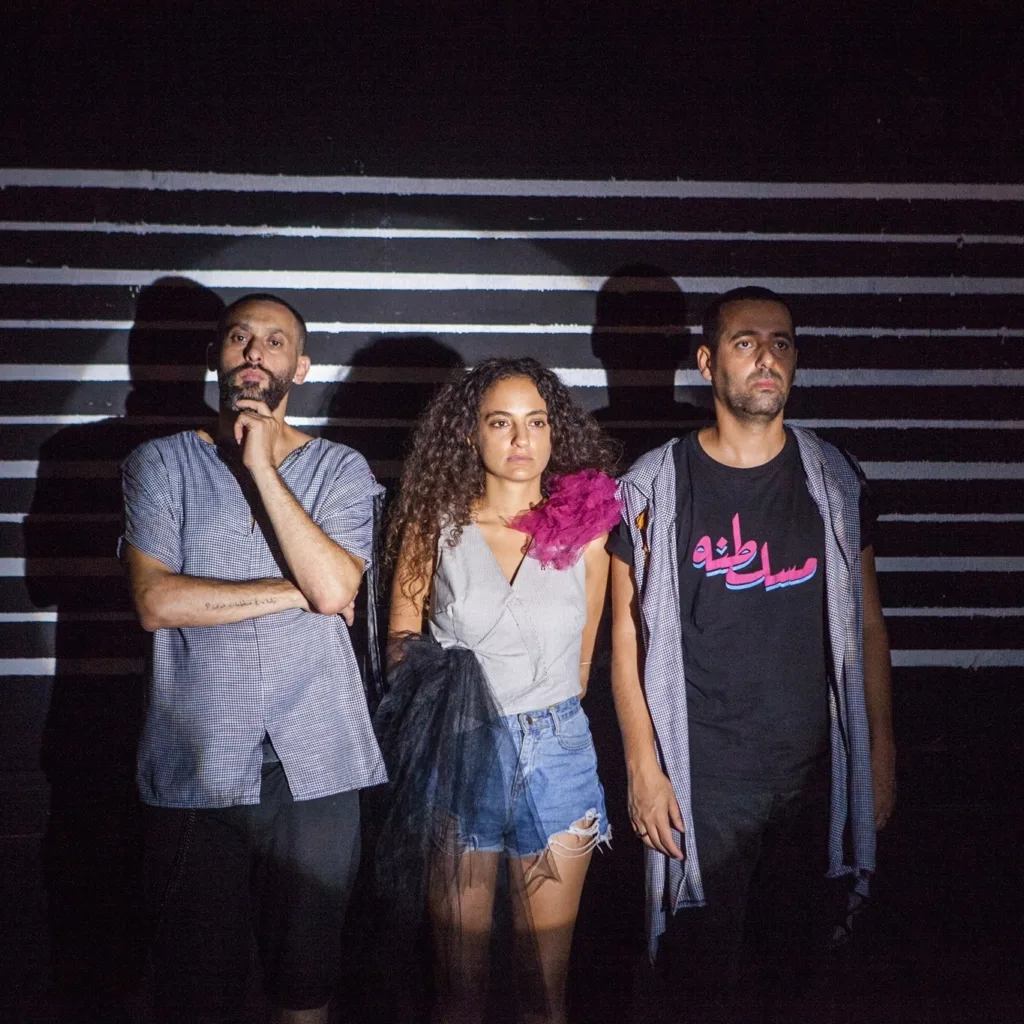
Maysa Daw, who would only join the crew later on, had to interfere with laughter, learning only then that “MIM MIM” was written in opposition to Tamer. They all laugh before Tamer adds, “But they still came to me to write the chorus.” Mahmood then directs his words to Nafar: “We’ve been through a lot together, Tamer.”
When the Music Found Its People
Throughout all of this, I felt like I became part of the crew, reminiscent of times I wasn’t even a witness of in real time. Maysa, though not a member at the time, was already an avid listener. She recalls,
“Ihda’ was the first time I heard alternative music in Arabic. I was missing Arabic music lyrics that I feel connected to. There was pop music and love songs, but this wasn’t something I felt connected to. And DAM, on the contrary, made this change. I remember we were a group of girls, I’m talking 12-14 years old, who had memorised all of DAM’s songs,” she continues.
“We were in a period when we wore loose clothes and put on caps and we would sit and sing their songs. It’s almost like they inspired a whole generation to make music and make alternative music. It’s as if a whole generation became aware and able to talk about topics that we didn’t know how to find the words to talk about.”
Suhel admits: “At the time, Arabic rap wasn’t something we had seen or even knew existed. So we were building something we had never heard before. A lot of people didn’t understand our vision or the kind of music we were trying to make, and they even questioned the way we dressed, the baggy clothes, the movement, everything that came with it.”
This is why DAM was deeply committed to building awareness around what hip-hop really means. They even had their own radio show called Wein Ya Warde, where they broke down hip-hop culture and explained why it mattered and how many communities are gaining visibility through music.
“I remember the day “Gasolina” by Daddy Yankee came out, we had to explain to our listeners what this new genre called reggaeton was, what it was doing globally, and how Arabic music could be the next wave, the next sound coming up.” Suhel continued.
Suhel wasn’t mistaken, Arabic music was the next wave. As in Maysa’s case, Ihda’ became an introduction to rap for many young Palestinians, offering music that spoke directly to their own lives. It allowed a generation to see at least the next step, even if not yet the horizon.

Pop Culture Editor-At-Large at Complex MENA.


