

Thirteen years in, UNTY isn’t just a streetwear label—it’s a visual language shaped by Cairo’s chaos, humour, and contradictions. Established in 2013, UNTY is a Cairo-based label focused on the intersection of iconography and functional design. What started as a gap in the market quickly turned into one of the city’s most recognisable creative voices, blending Arabic type, subculture references, and sharp social commentary.
UNTY returns with its SS26 collection, the brand’s first major release after a nearly two year hiatus. More than a comeback, the drop signals a sharper new chapter, leaning into structural maturity, elevated essentials and pieces built for the pace of the city. According to Mobarek, the comeback collection, ‘Translates sensory experiences into a more refined aesthetic, bridging the gap between intentional, elevated workwear and the brand’s signature graphic essence’.
As the brand hits its 13-year mark and celebrates its new drop, we sat down with its founder to talk about the early days, accidental breakthroughs, cult designs, and the story behind that missing ‘I’.
Complex MENA: UNTY is turning 13 this year, tell us a little about its inception and how the idea came to you.
Omar Mobarek: In around 2010, when I was living in Seattle, a Norwegian friend of mine really put me onto streetwear. There, everyone is in flannel, like Kurt Cobain core, so this guy comes rolling up fresh and opens my eyes to the concept of streetwear. Growing up in Southern California with its skate and surf culture, I got a lot of influence from there as well. When I moved to Egypt later that year, I realised there weren’t any brands doing this, so something clicked.
Complex MENA: So, why did you drop the ‘I’ in the spelling of UNTY?
Read More
OM: The name came to me pretty quickly; I wanted something I could do anything with. I had many interests – music, drawing, fashion, art, and I wanted something to bring all that together. When I was designing the logo, the ‘I’ just felt in the way, so I dropped it. I’ve lived through thirteen years of un-tee, aunty, un-tie. It’s happened to me where someone was like yoo, I love un-tie. Cool bro, put me onto whatever that brand un-tie is.
Complex MENA: What was it like coming up in Egypt as one of the first and only streetwear brands? And what was your vision for UNTY when you started out?
OM: At the time, I didn’t know anything, I didn’t understand the market. Back in the day, you had to sell the whole idea, the product, sell the concept of being a designer in the first place. It was a privilege to have that completely open canvas. I had a lot of room to make mistakes, learn from them, and evolve at my own pace.
I began to understand what streetwear is and what it represents to a city. It took me a few years to grasp how people think and be able to translate that into something tangible rather than just a graphic t-shirt. Anyone can make a graphic t-shirt, but how do you build something that can have an effect on people, and have them come back and commit to you; make them feel like you represent them. That was the whole journey for me.
Complex MENA: Arabic type and iconography are core to UNTY. How did the brand evolve into that visual language?
OM: I stumbled on that completely by accident. The collection that changed everything was the one inspired by Cleopatra cigarettes. It was a pivotal moment because it was the first time I created something that felt relatable to the culture and the people, and it came from the city. It was honestly by accident, and the reception was huge. This is when I realized that having a brand that represents a city was really important.
I then figured out a process. I would blend certain things, like small iconography, and a saying to create a different context. I used this image of The Wound Man, it’s a diagram of the injuries received in battle, just some person who’s completely shred to pieces, and I called him The UNTY Man then placed a quote by Nagib Mahfouz that says, ‘What brings people together is collectively suffering’. Together they had a whole different meaning that represents UNTY’s voice, which is a little bit dark, but there’s a sense of humour in it as well. The more I did this, the more i was able to create designs that didn’t feel like something you’ve seen before, but you could still relate to and it feels like it’s coming from Cairo.
Complex MENA: When creating type, where do you get your inspiration from and what’s your creative process?
OM: With Arabic type there’s so much space, I try to push the boundaries of what Arabic can look like. I’ll take something like a hardcore metal aesthetic, or I’ll look into jungle drum and bass record labels’ logos and bridge that with Arabic, then you create something new.
I’ve worked with shampoo, ketchup, sand. I’ll put it out on paper, I’ll smear it, I’ll hold it up so it dribbles down. I think when you begin to contextualise typography in anything, you’ll see it everywhere. Sometimes I take photos of random stuff then I’ll isolate it and put it together to make type. The city is an endless pour of inspiration. It’s an explosion of colour, sound, scents – all of your senses are activated all at once, it’s crazy, so I guess that’s my relationship with Arabic type.
Complex MENA: UNTY x Shabjdeed was an iconic moment for the brand. How did you guys find each other?
OM: I feel like if I ever made a reality show about UNTY this would be an entire season in itself. I got to know Shabjdeed before his big come-up and the relationship evolved pretty nicely over the years before the idea of a collaboration came up. He’s not a designer, but has an extremely creative mind. When I asked him what he likes the first thing he said was Evangelion New Genesis, an anime show from the 90s. When I saw the Evangelion logo, I was able to rearrange the Japanese lettering into Arabic to read Shabjdeed. I did a little design on the back, he gave me lyrics from an unreleased song, and it was done. It was one of the quickest, easiest designs I’ve ever worked on.
The video we ended up making was a crazy project, I wanna press on how incredible that was because of the efforts of Zeyna Salem. She made a video with 700+ frames cut out and scanned from videos that we took of Shabjdeed before he left because we didn’t have a sample to shoot him in. It took a couple of months to complete. The track on the video is an unreleased track, it was exclusively released for this collection. To this day this was one of my proudest projects.
Complex MENA: Certain designs have come and gone, but one that stands out is ‘Berahetha’. What’s the story behind that design?
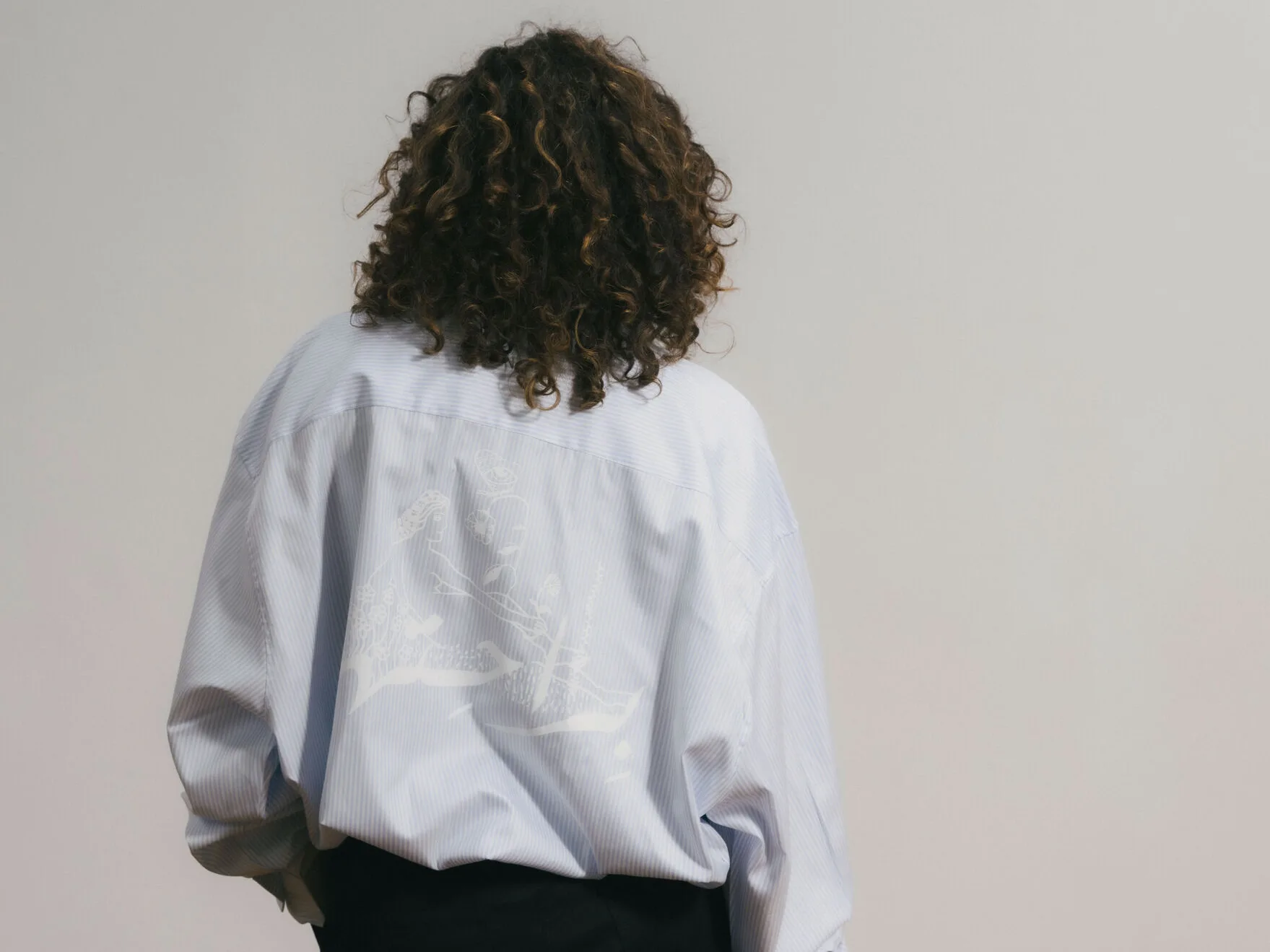
OM: This happened in a collection called Cairofornication. I was driving out of Maadi and I saw a microbus which has a big sticker on the back that said ‘Berahetha’. To me, that was super ironic. Having the word ‘Beraheta’ in the context of the street, it was comical. The actual illustration is from a painting from the 1700s of a harem. The painter himself broke a lot of rules when it came to painting and proportions. He drew her how she felt inside I think. Revealing herself in a way where she’s unbothered. I thought it was perfect to represent ‘Berahetha’. I’ve always tried to bring it back in a different form, different cut, different colour. I think it’s a very strong message and everyone has their preference with it, but I like to see this design have a new life every release. I don’t know if someone’s out there that’s got all of them, I don’t even have all of them, I’m horrible at archiving.
Complex MENA: As well as celebrating 13 years of UNTY, you’re launching a long-awaited collection. What should we expect?
OM: Several things pushed this collection. A year into UNTY, I partnered up with Omar Fayez who was living in Germany and after a while, the relationship started to fade and I was alone for about eight, nine years. At the beginning of last year, he decided to move back and wanted to bring UNTY back. This was music to my ears since the last collection had been almost a year and a half before.
We found a new, incredible factory. One of the most difficult parts of this whole process is just when you think that you’ve got it and it’s streamlined, things come up and derail you. So, with this new release, I’m not testing the new relationship too much, but we’re making new jackets and pants; I wanted to introduce elevated essentials with the graphics. It’s a representation of UNTY in the sense that the graphics are still there, but you can dress up with this brand as well. You can go out casually or in a more formal setting. I don’t want to be limited to just a graphic t-shirt brand; I want to delve into tailored options. I’ve personally matured a lot as a person and as a creative, and I want this evolution to show in the brand as well.


